What type of technology is being used to study the brain?
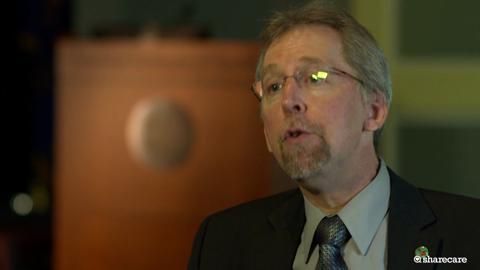
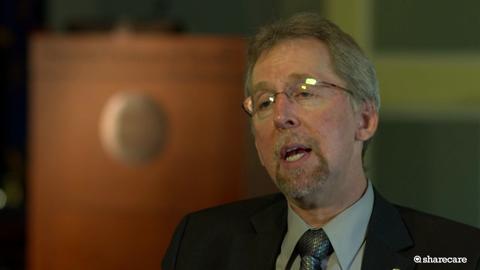
Francis Collins, MD, PhD, former director of the National Institutes of Health explains what's needed to bring new technology to the forefront of research to study the brain.

Transcript
That's becoming more and more clear. The only memories you should trust are the ones you've never retrieved. That doesn't help you so much.
As soon as you recall something, you have to rewrite it when you replace it, where it came from.
Well, such as the ability to have various kinds of electrodes that can actually see what's happening for millions
of neurons at one time, other kinds of imaging procedures, PET scans that you can walk around with instead of being stuck in some donut where you can't
really have much in the way of visual experiences, try to understand what's going on there, new kinds of ways to sample when a neuron fires that you know
it did, ways that you could-- with animals, anyway-- see if you could even transfer a memory from one animal to the other electrically and see whether that would work.
People are starting to learn how to do that. All of that-- complicated, demanding, needs to bring in lots of engineers and robotics
experts, computational experts. This is going to be a big data problem. That's for sure. And I think there's enough sense here
that we're on the right moment, the cusp of an opportunity here to make a big push.
And that's what we're doing because without the technology, we're kind of stuck with a big, blank space here
and-- in terms of those circuits because right now, we have not had the ability to see what they're doing in a real-time experiment.
And that's what we need to know. What's going on with memory? What's the molecular basis of memory?
Why is it that when you retrieve a memory, you actually change it a little bit and then you put it back? That's becoming more and more clear.
The only memories you should trust are the ones you've never retrieved. That doesn't help you so much. As soon as you recall something, you have to rewrite it
when you replace it, where it came from, which means it may be slightly altered by your recollection of--
or telling the story. Fascinating, but wouldn't you like to know what is actually going on there
electrically and in terms of small molecules or large molecules? We don't know. Wouldn't that be an amazing achievement, to understand that?
Would we ultimately even get to the real holy grail of neurosciences? What is consciousness?
genetic disorders birth defects




Browse videos by topic categories
A
B
C
D
E
F
G
H
I
J
K
L
M
N
O
P
Q
R
S
T
U
V
W
X
Y
Z
ALL