Updated on May 5, 2025.
More than 1 in 10 people in the United States live with diabetes. The vast majority of those have type 2 diabetes, in which the body doesn’t use insulin properly. About 5 percent have type 1 diabetes, in which the body doesn’t produce insulin at all. But there is another type of diabetes that develops only in people who are pregnant: More than 8 percent of pregnancies are affected by gestational diabetes (GD).
Understanding gestational diabetes
When you eat, your body produces a hormone called insulin. Insulin helps move blood sugars into cells so they can be used as energy. During pregnancy, hormonal changes can reduce your cells’ ability to use insulin. This may cause insulin resistance leading to increased blood sugar levels.
All pregnant people experience some insulin resistance later in their pregnancy. Most will make more insulin to compensate. But some are unable to produce enough of the hormone, causing higher blood sugar levels, which can lead to GD. As with type 2 diabetes, being overweight increases the risk for gestational diabetes.
“I think of gestational diabetes, in some ways, as being a manifestation of modern life. It has the hallmarks of type 2 diabetes, where there's resistance to insulin and there are high glucose levels,” says Bruce Chen, MD, of the Fetal Diagnostic Institute of the Pacific in Honolulu.
GD is usually diagnosed towards the end of the second trimester. If you have certain risk factors, you may develop it earlier.
Some people are at greater risk
In the U.S., it’s recommended that all pregnant people be screened for GD, usually between 24 and 28 weeks of pregnancy. This involves one or two tests. The first test involves drinking a sugary beverage and then giving a blood sample an hour later. If blood glucose levels are in the normal range (below 140 mg/dL), further testing is not necessary. If the test shows a higher blood glucose level, you will need to go back for a longer test. You’ll be asked to fast before the test, and your blood sugar levels will be measured before and after drinking another sugary beverage.
Any pregnant person can develop GD, but some are more likely to be diagnosed than others. Factors that put you at higher risk include:
- Being older than 25
- Having a body mass index (BMI) at or above 25
- A history of GD in a previous pregnancy
- Having delivered a previous a baby who weighed more than 9 pounds
- A family history of type 2 diabetes
- Polycystic ovarian syndrome (PCOS), a hormonal condition that causes many small pockets of tissue called cysts in the ovaries
- Being of African American, Hispanic/Latino, Native American, Alaska Native, Native Hawaiian, or Pacific Islander descent
Just because you have one or more risk factors doesn’t mean you’re destined to get GD. Pregnant people can lower their risk by watching what they eat, staying active, and avoiding excessive weight gain, says Dr. Chen.
Complications that may arise
Uncontrolled GD can increase the risk for several complications, including:
- Preeclampsia, high blood pressure during pregnancy
- Having a baby who weighs more than 9 pounds, which can make delivery more difficult
- Having a cesarean delivery (C-section)
- Preterm delivery
- Infants born with low blood sugar
- Infants having difficulty breathing at birth
Keep in mind that even if you’re treated for GD, your fetus may still grow very large, which may require a C-section.
Managing GD
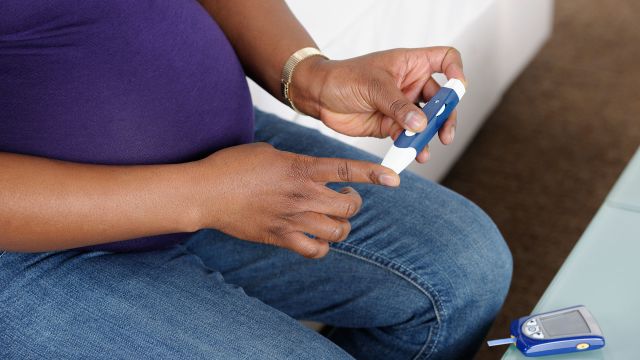
In many cases, GD can be managed with lifestyle adjustments, including a healthy diet and regular exercise. People with GD are usually asked to monitor their blood glucose levels and report the numbers to their healthcare provider (HCP) to determine an appropriate eating plan. Regardless of risk factors, pregnant people are usually encouraged to engage in at least 150 minutes of moderate-intensity exercise (such as brisk walking) each week, according to the American College of Obstetricians and Gynecologists. Check with your HCP about what type and amount of exercise are right for you.
Chen recommends that his pregnant patients eat three moderately sized meals a day and three snacks between meals. “We're taking the whole meal plan and spreading it out more evenly through the day, so you don't get huge loads of carbohydrates,” he explains. He also encourages his patients to pay attention to the nutritional makeup of those meals. “Most people in the U.S. are eating 50 to 60 percent carbs in their meals. We try to get 30 percent carbs, 40 percent protein, 30 percent fat.”
If diet and exercise are not enough to bring your blood sugar levels down, you may need to take insulin through the remainder of your pregnancy.
Long-term outlook
In most cases, medications or special eating plans used to manage GD are temporary. Treatment typically ends if the condition resolves after delivery.
“It's remarkable,” Chen says. “As soon as delivery happens and the placenta [the organ that develops inside the uterus during pregnancy to support and nourish the fetus] is out, glucose control is often restored very quickly, in a matter of hours.”
However, GD does not resolve on delivery for everyone. In some cases, the parent may have had undiagnosed diabetes before pregnancy. Others may have been progressing toward diabetes, and the pregnancy accelerated development of the condition.
It’s also worth noting that while GD is usually temporary, it’s also a predictor for future health concerns for parents and their children. People who are diagnosed with gestational diabetes are at increased risk of developing type 2 diabetes later in life. Children born to people with GD are also more likely to become obese and develop type 2 diabetes as they get older.
“The statistics vary based on which population you look at,” says Chen. “But the general statistic I like to quote is that five years out from a pregnancy with gestational diabetes, about 15 percent of women will be type 2 diabetics. And 15 years out, 50 percent of them will be.”
If you had GD with one pregnancy, you can reduce your risk of developing type 2 diabetes later in life by returning to a healthy weight after pregnancy and maintaining a healthy lifestyle. If you’re having trouble losing the weight you gained while you were pregnant, talk to your HCP. They can help you find an eating and exercise program that works with your lifestyle as a new parent.