What makes someone a good candidate for plastic surgery?
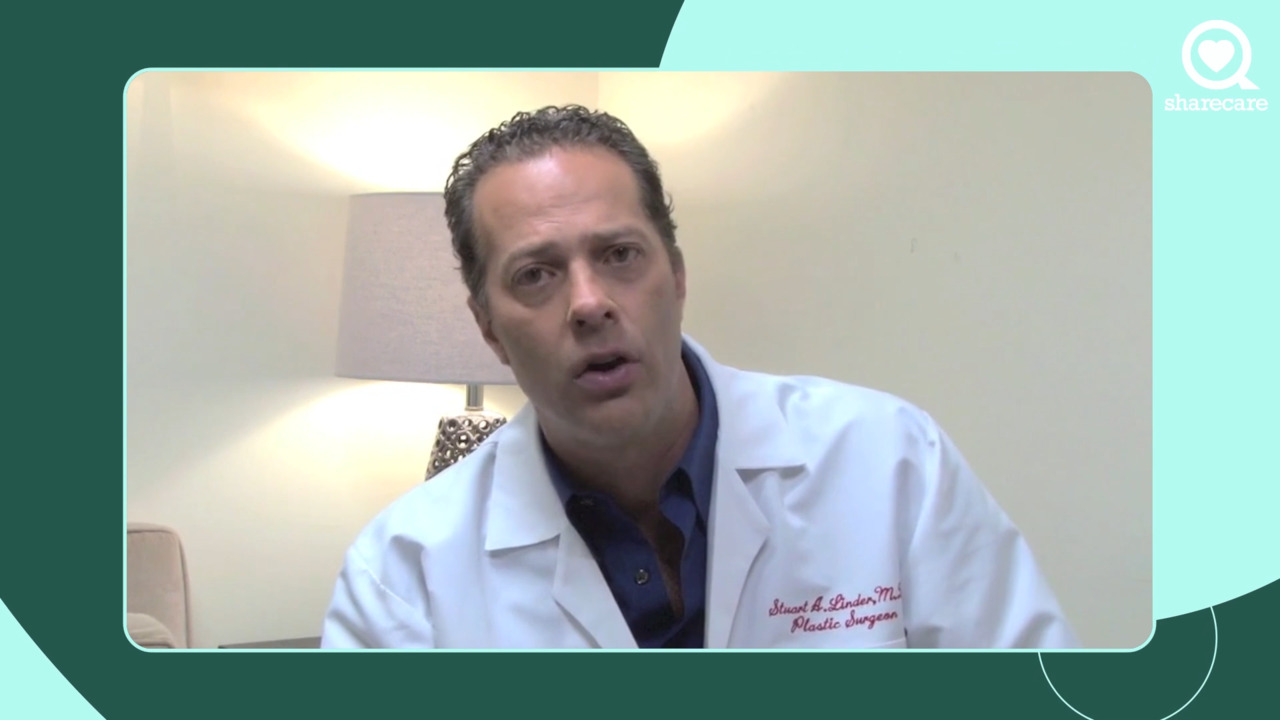
Stewart Linder, MD, discusses the process for plastic surgery and what information patients should know before they choose their procedure.

Transcript
When you're dealing with scars on big surgeries such as breast reductions, breast lifts, and tummy tucks,
they're very intense scars. They don't always heal perfectly, and that's not always within my hands. That's often with just the way the body heals.
Patients have to be accepting of these scars. [MUSIC PLAYING]
When we're looking for candidates for cosmetic surgery, we have to look at several factors. It's multifactorial. Number one, you have to look at them
and make sure they're a candidate for the procedure, OK. A woman, for example, may want liposuction but she's had three kids and she has loose skin.
She needs an abdominoplasty or tummy tuck. That is not a candidate for lipo and if they're going to have expectations of getting a good result with the wrong procedure,
they're in the wrong terminal at LAX so we're not operating on that patient. The correct surgical procedure must be performed.
Otherwise, you're going to have obviously a very poor result. Health is extremely important when you're dealing with candidates for plastic surgery
just like any operation. Cosmetic and plastic surgery is real surgery. It's not beauty surgery or a beauty appointment
or a manicure. This is major surgery performed under general anesthesia with board certified anesthesiologist,
and you absolutely need to be healthy just like any other operation, OK. Majority of these are elective surgical procedures,
so we don't per se have to do these. These aren't emergency appendectomies or, you know,
mastectomies for cancer. These are patients who want to have elective operations. We look at their health, and we want
to make sure that they don't have any serious systemic diseases including diabetes, high blood pressure, severe anemia, or, you know,
seizures or anything else that could cause them to end up in the hospital or end up having a morbidity or mortality.
We look to make sure that they have realistic expectations. Some patients don't. As a plastic surgeon, I have to be
able to determine if the patient is psychologically ready for the operation and has realistic expectations
as to whether this surgery is going to make that patient happy. We make sure our patients have done their due diligence, and I do a lot of time in consultation discussing
risks and complications of these operations, especially with the scarring. When you're dealing with scars on big surgeries such as breast
reductions, breast lifts, and tummy tucks, they are very intense scars. They don't always heal perfectly,
and that's not always within my hands. That's often with just the way the body heals. Patients have to be accepting of these scars.
If they're not, they're not a good candidate for these operations. Bad candidates for plastic surgery
are patients who have absolutely ridiculous, unrealistic expectations. I see these patients all the time in my practice.
Patient comes in, wants breast implants, for example, and has what we call grade three skin laxity, which
means sagginess to the breast that's severe enough that by standards of the American Board of Plastic Surgery absolutely requires a breast lift.
The breast lifts we perform most often are filled with scars, and it's called an anchor scar around the nipple,
down, and underneath the crease. And that's a lot of scars. But in order to correct a patient such as that
that we just discussed with grade three ptosis, you have to do that operation. If they want increased volume, you put an implant.
If they want the skin lifted, it isn't going to happen with an implant. And if they're not willing to have scars with the breast lift, right then and there that patient
is not a candidate for the surgical procedure, and you can just tell in consultation just speaking with them, showing them pictures of the scars,
looking at their facial expressions. Patient who has severe medical history including, again, diabetes, high blood pressure, anemia, seizures, cancer,
or some type of ongoing autoimmune disease may not be a good candidate for any surgical procedure including plastic surgery.
surgery









Browse videos by topic categories
A
B
C
D
E
F
G
H
I
J
K
L
M
N
O
P
Q
R
S
T
U
V
W
X
Y
Z
ALL