Updated on September 10, 2024.
Staying active is key to a long, healthy life. There are many ways to get moving, from playing sports to spending time at the gym. For stroke prevention, an activity as simple as walking can be a surprisingly powerful ally.
The importance of movement
Exercise boosts physical and mental health, and it has both short-term and long-term protective benefits. Government experts recommend that, each week, adults get at least 150 minutes of moderate-intensity aerobic exercise or 75 minutes of vigorous-intensity aerobic exercise. And these are just the minimum recommendations—more is better.
Exercise has wide-ranging benefits for your health, including stroke prevention.
A strong link
About 9 in 10 strokes are caused by preventable, modifiable risk factors—primarily smoking, an unhealthy diet, and lack of exercise. This means that people who have not had a stroke can take action now to help prevent having one in the future.
Those who’ve already had at least one stroke can still modify their risk through lifestyle changes. The American Heart Association (AHA) recommends that those who’ve had a stroke in the past should make sure to avoid long periods of sitting and that they should get up and exercise regularly.
A 2021 study published in the journal Neurology found that those who’d had a prior stroke could lower their risk of death from all causes by 54 percent just by walking or gardening for three to four hours each week or biking two to three hours per week. For stroke survivors under age 75, the risk reduction may be as much as 80 percent.
Brisk is best
When it comes to stroke prevention and walking, pace matters. A 2022 study published in JAMA Network Open looked at a week’s worth of data from accelerometers (which can be found in cell phones and detect motion, such as from movement or exercise) for more than 7,600 participants. Then, they tracked the incidence of strokes over the next two and a half years.
Highly sedentary participants had a 44 percent higher risk of a stroke. However, those who engaged in light-intensity physical activity or even very short bouts of moderate-to-vigorous physical activity lowered their risk of stroke.
A 2020 study published in the journal Stroke looked at more than 360,000 participants’ stroke risks and self-reported walking speeds. They found that for those 64 or older, slow or even average walking paces (defined as three miles per hour or three to four miles per hour, respectively) were linked to a higher risk of stroke.
And a 2020 meta-analysis published in the Journal of Sport and Health Science quantified the benefits of each speed. They found that each incremental rise of one kilometer per hour in walking pace lowered the stroke risk by another 13 percent in older adults.
Tips for walking
To get moving and keep moving on a consistent basis, it helps to set yourself up for success.
Strategies
To build a healthy habit like walking into your routine, here are a few tricks to try:
- Find a walking companion—whether human or dog—to help make the walk more fun and safe, and to help you stay accountable.
- Vary your walking route to keep it interesting.
- Track how long and how far you walk to feel a sense of achievement.
- Schedule it on your calendar to help you take it seriously.
- Come up with a plan for if it’s raining, like walking at an indoor shopping center.
Gear
Aim for walking gear that both feels good and protects you from the elements. This includes:
- Layers to help you adjust to different temperatures and comfort levels
- Weather-ready gear, like a wind-proof or rain-proof jacket
- Light, non-bulky fabrics that wick moisture to help it evaporate, like polyester, nylon, spandex, or lightweight merino wool
- Snug-fitting socks
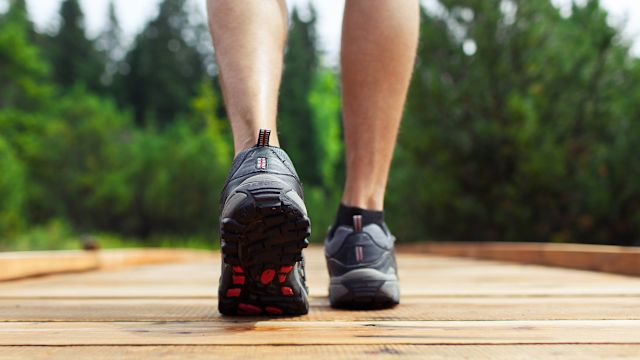
- Flexible walking shoes that don’t pinch your toes and have a pretty flat, straight heel
Safety
Adequate water, sunglasses, hats, and sunscreen are all essentials, no matter the season. To help motorists see you, wear reflective or colorful clothing or stripes. If you’re going into nature, bring some bug spray and tick repellent.
Don’t forget to make it fun, and listen to your body to make sure you don’t push it past its limits.