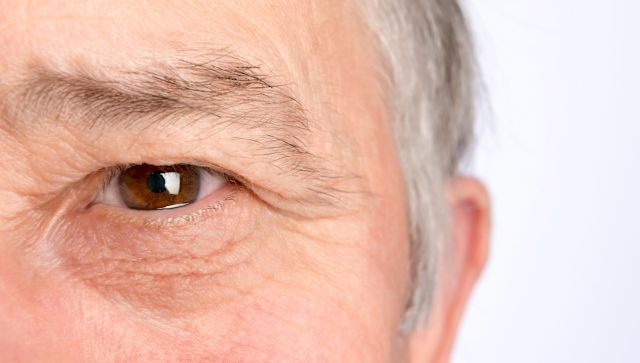
With aging comes sagging skin, caused in large part by your body's gradual loss of the proteins collagen and elastin. But when it's your eyelids that sag, the problem may go deeper.
Why it happens
Droopy eyelids (the medical term is ptosis) can be caused by several factors, says Erik Hoy, MD, a board-certified plastic surgeon at Premier Dermatology & Cosmetic Surgery in Newark, Delaware. "Lack of sleep or fatigue can decrease how well the muscles of the upper eyelid function. When this occurs, the lid settles lower," he says. In rare cases, droopy eyelids can be a symptom of myasthenia gravis, a neuromuscular disease.
But most of the time, the aging process is to blame. "As we get older, we build up a layer of fat in the upper lid, and the skin stretches. This extra skin and fat, combined with looser connective tissue seen in older age, can cause droopy lids," says Dr. Hoy.
Who's at risk
"Physicians don't have a good way to predict who will have upper eyelid ptosis, but there are some helpful hints," says Dr. Hoy. First, there's a genetic component to the problem, so if your parents and older siblings have upper eyelid sagging, there's more of a chance that you will, too. Other factors that can increase your risk include rapid weight loss, sun exposure, chronic stress, fatigue, insufficient sleep, and chronic illness.
When it's a problem
While in many cases droopy, aging eyelids are a purely cosmetic issue, for some people it can also impair their vision. "When part of the lid—usually the outer or lateral portion—obstructs the visual fields, loss of function occurs. In other words, patients can't see objects in the upper parts of their visual field because the skin blocks their sight here," says Hoy.
"I see patients on a daily basis who have a loss of peripheral vision due to droopy lids," says Deborah Sherman, MD, an ophthalmic plastic surgeon in Nashville, Tennessee. She says many patients who have surgery to correct the problem report an improved quality of life while driving and performing other daily tasks. "One patient told me she felt as though a window shade had been lifted, she could see so much better," she said.
How to fix droopy eyelids
The surgical procedure to correct droopy eyelids is called blepharoplasty or eyelid-lift. During the surgery, which can be done under local or general anesthesia, the doctor will remove excess skin and fat from the upper lid. Incisions usually heal in a few days, but the swelling can take one or two weeks to go down.
If vision tests performed by an ophthalmologist confirm that droopy, aging eyelids are impairing your vision, the surgery may be covered by your insurance. A pre-surgical evaluation by an ophthalmologist is also important to rule out overly dry eyes, because the procedure can make dry eyes worse.
While plastic surgeons, otolaryngologists (ENT doctors) and some cosmetic dermatologists offer eyelid surgery, ophthalmic plastic surgeons tend to have the most training and experience.